We are living inside multiple crises — political, economic, ecological, relational. In times like these, it is tempting to shrink our imagination, to settle for survival and call it victory.
EJ never accepted that narrowing.
To reimagine feminist futures is not a branding exercise. It is a commitment to building a world where dignity is non-negotiable — and where women, girls, and gender-diverse people are not asked to endure violence as a normal condition of life.
Futures are built through choices we make now
A feminist future does not arrive as a gift. It is constructed through everyday decisions about power:
- Who speaks and who is silenced?
- Whose labour becomes invisible?
- Who is protected, and who is disposable?
- Whose stories are believed?
Reimagining the future means redesigning those answers — in our movements, organisations, policies, families, and communities.
1) A feminist future is cross-generational by design
Some movements break because they forget their elders. Some stagnate because they fear their youth.
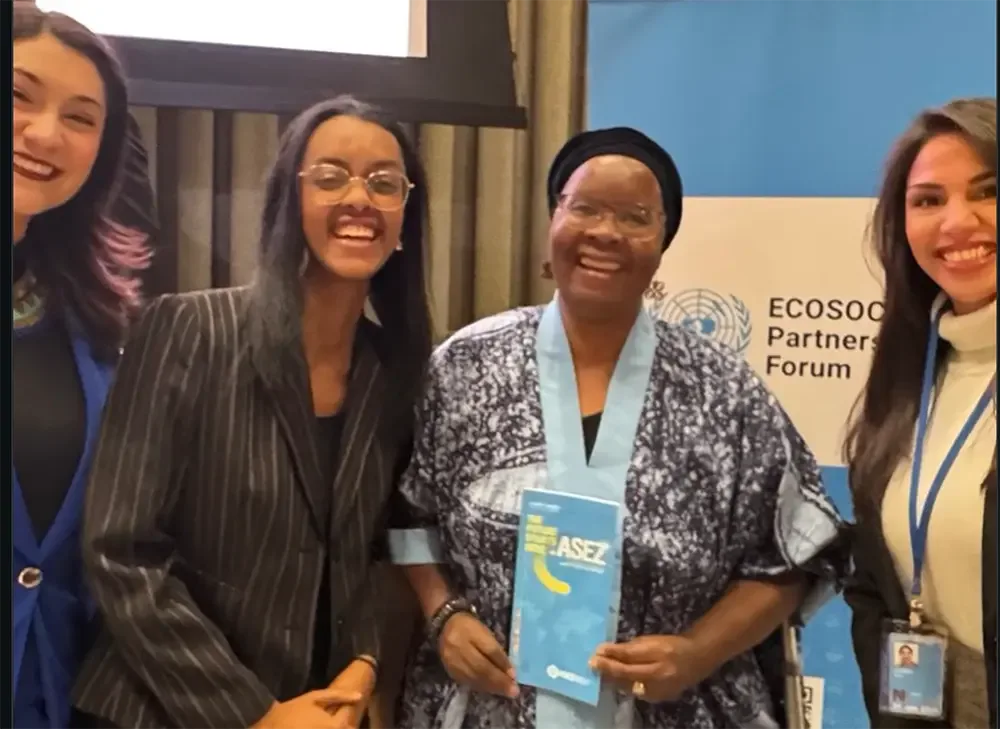
EJ insisted on cross-generational practice: learning that moves both ways. Elders offer context, memory, and hard-won strategies. Younger feminists bring new language, new tools, and new risks they are willing to take. When generations collaborate instead of compete, the movement becomes resilient.
A feminist future is not a single “generation’s project”. It is a relay — carried together.
2) A feminist future refuses the politics of scarcity
Scarcity politics teaches us to fight over crumbs: funding, visibility, seats at tables, “spotlight moments”.
But EJ’s words point to a different reality: there is enough room in the sky.
Imagine movement spaces where:
- credit is shared
- resources are redistributed with integrity
- collaboration is valued more than competition
- solidarity is measured by behaviour, not slogans
Reimagining feminist futures means choosing abundance as a practice — even when resources are constrained.
3) A feminist future is organised around care, not control
Care is not an aesthetic. It is a system.
A care-centred future asks different organisational questions:
- How do we prevent burnout instead of romanticising it?
- How do we build safety without becoming punitive?
- How do we handle conflict without creating harm?
- How do we make leadership sustainable?
In care-centred feminist practice, people matter more than performance. We build structures that can hold grief, disagreement, transition — and still remain functional.
4) A feminist future makes room for joy
Joy is often treated as optional — something we earn after we “fix everything”.
But joy is not a luxury. It is how we remember what we are fighting for.
When joy is present, movements become more magnetic, more durable, and more human. Joy is also a form of resistance: the refusal to let violence shape the limits of our lives.
5) A feminist future is accountable — and still compassionate
Accountability is not the same as punishment.
Feminist futures require cultures where people can be called in, repaired, and transformed — without protecting harm or silencing survivors. That takes maturity, process, and commitment.
EJ’s approach reminds us: the goal is not to be “perfect feminists”. The goal is to build communities that can learn — and keep moving.
Where we go from here
Reimagining feminist futures is not about predicting what will happen. It is about deciding what we will build.
If you want to engage:
- Explore Our Work and the spaces we are nurturing.
- Learn about the Fellowship and cross-generational mentorship.
- Support the Foundation’s work by donating.
May our future be bold enough to hold our full humanity — and organised enough to defend it.